The UK data centre market has a geography problem. Approximately 75 to 80% of the country’s colocation capacity sits in London and the Thames Valley. The same corridor that hosts the majority of UK digital infrastructure is also the most power-constrained environment in the country, where grid connections stretch to a decade, substation capacity is spoken for, and the available land for new development is almost exhausted.
The result is a market under pressure from both sides. Developers cannot find sites with power. Offtakers cannot find capacity at the scale, specification, or timeline they need. And the infrastructure required to relieve the pressure — new substations, upgraded transmission lines, additional ring-main capacity — is measured in years, not months.
This article maps where data centre power is genuinely available outside the M25, what regional markets currently offer, which are developing fastest, and how to evaluate a regional option against a London alternative.
Why London has run out of power
London’s data centre vacancy rate stood at 7% in Q1 2026, with take-up forecast to reach 189MW in 2026 — the fifth consecutive year demand has exceeded new supply. The traditional development corridors around Slough, Hayes and Park Royal are power-constrained. The substation upgrades required to open new capacity in West London are not expected to complete until the early 2030s.
New supply is pushing outward by necessity. Within the London cluster, new capacity is being built in North London, Oxfordshire, Hertfordshire, the Docklands, and Essex — areas adjacent to cloud availability zones where power availability is greater than in the core corridors. But even this expansion is bumping against the same constraints further out: the grid is congested across the South East, not just in Slough.
Savills H1 2026 data shows that 91% of live UK IT power capacity sits within the London market. That concentration is not primarily a choice — it reflects the depth of connectivity, the cloud availability zone ecosystem, and the enterprise demand density that London offers. But it also reflects the historical accident of where investment went when power was abundant. That calculation is now changing.
The most constrained data centre market in the UK is also the largest. That is not a coincidence — concentration created the constraint. The question for developers and offtakers is whether the advantages of London still outweigh the increasing cost and difficulty of operating there.
Regional markets: where power is available and what they offer
Manchester
Manchester is the UK’s second data centre market, with a growing colocation cluster and improving connectivity infrastructure. The city benefits from lower land costs than London, more available grid capacity in some corridors, and a growing technology sector that provides both talent and enterprise demand.
Manchester suits deployments where London proximity is not a hard requirement — regional enterprise IT, backup and disaster recovery, AI training workloads, and increasingly, inference capacity serving Northern England and Scotland. Pricing runs 15 to 30% below the M4 corridor on a per-kW basis, which makes a material difference over a five-year colocation contract.
The connectivity picture in Manchester has improved significantly. The city has multiple carrier-neutral colocation options, diverse fibre routes, and latency to London that is adequate for most enterprise and AI workloads. For applications requiring sub-5ms latency to London financial infrastructure, Manchester is the wrong answer. For most other requirements, it is a credible alternative.
The North East and Humber
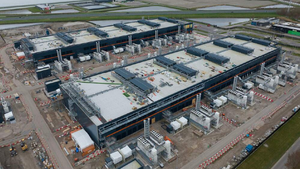
The North East has been designated an AI Growth Zone, giving it a structural advantage in terms of grid prioritisation and planning support for large-scale data centre development. The former Blyth power station site at Cambois in Northumberland is being developed into a major data centre campus — a 720MW facility backed by Blackstone, representing one of the largest single data centre commitments in the UK outside London.
The North East’s attraction for large-scale development is principally power. Legacy industrial infrastructure of former power stations, chemical plants, steelworks, has left a network of high-voltage grid connections that are materially easier and faster to access than anything available in the South East. The Humber Technology Park alone is planned to deliver 384MW of capacity, anchored by legacy industrial power infrastructure.
The trade-off is connectivity depth and talent availability. The North East does not have the carrier-neutral ecosystem or the fibre diversity of London. For the AI training workloads that make up the majority of hyperscale demand — where latency to end users matters less than power cost and availability — that trade-off is acceptable. For latency-sensitive applications, it is not.
Scotland
Scotland’s data centre pipeline has grown significantly, with the national development plan now spanning 22 or more facilities. The market’s advantage is structural: a high concentration of renewable generation relative to industrial demand, available grid capacity in the Central Belt, large land parcels at competitive cost, and a planning environment that has been broadly supportive of digital infrastructure investment.
The ILI Group’s 600MW Stoic campus application in Fife and Apatura’s 2.3GW of secured grid connections across nine Central Belt sites are the clearest signals of where serious development capital is positioning in Scotland. AI Growth Zone designation for Lanarkshire was confirmed in January 2026, adding grid and planning prioritisation to a market that already had structural power advantages.
Scotland’s latency profile is similar to the North East, it is adequate for AI training and batch processing workloads, less suitable for latency-sensitive applications requiring proximity to London infrastructure. The power cost advantage is meaningful: renewable generation in Scotland is available at lower cost than grid supply in the South East, and that difference compounds over the life of a data centre at high utilisation rates.
Wales
South Wales has been designated an AI Growth Zone and has attracted investment from several data centre developers attracted by available land, improving grid access, and lower development costs than England. North Wales similarly has AI Growth Zone designation.
Wales offers a different profile from Scotland in that it is closer to London in distance terms, with improving connectivity infrastructure and a manufacturing and engineering base that provides relevant technical labour. For developers looking for a regional alternative with better access to English enterprise demand than Scotland or the North East, Wales is worth evaluating.
The expanded London fringe
For developers and offtakers who cannot fully move away from London but need to escape the core constraints, the expanded London fringe of Oxfordshire, Hertfordshire, Essex, parts of Kent offers a middle ground. Connectivity to cloud availability zones is maintained at acceptable latency. Power availability is materially better than in Slough or Docklands. Land costs are lower, and some areas have grid capacity that was not spoken for five years ago.
Essex in particular has attracted significant development interest, partly because of proximity to the Docklands and partly because some parts of the county have accessible grid capacity that has not yet been consumed. The Nscale project at Loughton is the most prominent example — though its grid connection difficulties illustrate that even the London fringe is not immune to the constraints affecting the core market.
How to evaluate a regional option against a London alternative
The evaluation framework for a regional data centre site in 2026 should start with a clear-eyed assessment of which London advantages actually matter for the specific workload, and which are inherited assumptions rather than genuine requirements.
Latency requirements are the first filter. Sub-5ms latency to London financial infrastructure is a hard requirement for some workloads and irrelevant for others. Most AI training, batch processing, backup, and archive workloads have no genuine latency requirement that would rule out Manchester, Scotland, or Wales. Latency is frequently cited as a reason for London preference when it is not actually a constraint for the specific application.
Connectivity requirements are the second filter. Does the workload require carrier-neutral colocation with multiple network providers and direct cross-connects to cloud on-ramps? Or does it require reliable, diverse connectivity to the internet and to a corporate WAN? The former is more easily satisfied in London. The latter can be satisfied in every regional market on this list.
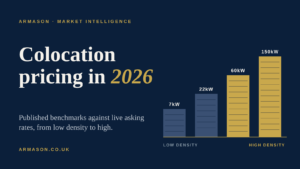
Power cost over time is the third filter, and is frequently underweighted in procurement decisions. A 10% difference in per-kW pricing compounded over a five-year contract on a 5MW deployment is a material number. For AI workloads running at 80% utilisation or above, power cost matters more than almost any other variable. The regional markets consistently offer lower power costs than the London and Thames Valley corridor.
Timeline is the fourth filter. A regional site with available grid capacity and a 12-month delivery timeline may be worth more than a London option that requires 24 months of pre-letting ahead of a constrained build programme. The theoretical advantage of the better location can be outweighed by the practical cost of delayed deployment.
The right question is not whether a regional site is as good as London. It is whether the specific advantages London offers for the specific workload are worth the additional cost, complexity, and delivery risk of operating in the UK’s most constrained market.
Sources referenced in this article
UK Data Centres Outlook 2026 — CBRE
UK data centre take-up continues to concentrate on London — Savills
Spotlight: UK Data Centre Building Capacity H1 2026 — Savills
UK data centre construction and AI Growth Zones 2026 — Astute People
UK data centre map: where the UK’s data centres are — Solar Panels for Data Centres