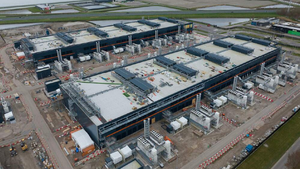
AI data centre in the UK: what hyperscale and enterprise AI infrastructure demand looks like in 2026
The UK data centre market has entered a new phase. For most of the past decade, demand was driven by enterprise cloud adoption, organisations migrating workloads from on-premise servers to cloud platforms, and colocation operators building capacity to serve that migration. That phase is not over, but it has been fundamentally complicated by a new and more demanding type of customer: AI.
AI workloads have different infrastructure requirements from any compute that came before them. They require higher power densities, more sophisticated cooling, faster connectivity, and critically, significantly more power per rack than facilities were designed to deliver. Understanding what AI data centre demand looks like in the UK in 2026, who is driving it, and what it requires is essential for anyone investing in, developing, or seeking to access UK data centre infrastructure.
The scale of AI data centre demand in the UK
The UK is Europe’s largest data centre market, with approximately 4,190MW of IT load capacity in 2026, projected to grow at a 30% CAGR to reach 15,598MW by 2031. That trajectory is driven overwhelmingly by AI.
Globally, nearly 100GW of new data centre capacity will be added between 2026 and 2030, effectively doubling total global capacity. JLL’s 2026 Global Data Centre Outlook projects the sector growing at a 14% CAGR through 2030, with AI representing up to 50% of all workloads by that date. Today, AI represents around a quarter of all data centre workloads, with training driving most of the demand. By 2027, inference workloads are expected to overtake training as the dominant AI requirement.
In the UK specifically, 83% of senior data centre professionals believe AI workloads will exceed their current capacity within two years. 74% say they are not fully prepared to support AI workloads today. The gap between declared demand and actual infrastructure readiness is substantial and widening.
The UK data centre market’s constraint is not appetite — it is the availability of genuinely deliverable capacity. Power, land, planning, and construction are all becoming binding constraints simultaneously.
Who is driving AI data centre demand in the UK
Hyperscale cloud providers
Hyperscale cloud providers — AWS, Microsoft Azure, and Google Cloud — account for the largest share of UK data centre demand and are expanding aggressively. Google announced a £5 billion investment in UK AI research and data centres in September 2025. Amazon’s £8 billion programme through 2028 is adding more than 1GW of capacity across multiple UK regions. Microsoft has expanded its estate across multiple UK sites to support high-density AI and sovereign cloud workloads.
Hyperscale providers are pursuing a dual strategy of leasing from colocation operators and self-building. For the largest AI training deployments, campuses requiring hundreds of megawatts, self-build is increasingly preferred, allowing hyperscalers to design facilities specifically for AI density from the ground up rather than adapting existing colocation infrastructure.
Neoclouds and GPU-as-a-Service providers
A new category of infrastructure provider has emerged directly in response to AI demand. Neoclouds — AI-native platforms that offer GPU-as-a-service optimised for AI training and inference, are now competing directly with hyperscalers for UK colocation capacity, accelerating take-up and pushing facilities to technical limits.
The GPUaaS market reached $7.38 billion globally in 2026 and is growing at a 28.73% CAGR. For UK colocation operators, neoclouds represent a rapidly growing customer segment with specific infrastructure requirements that standard colocation was not designed to serve.
Enterprise AI deployment
Enterprise demand for AI infrastructure in the UK is being driven by financial services, healthcare, media, and professional services organisations deploying generative AI at scale. Large enterprises dominate demand, accounting for 58.4% of UK data centre market size in 2025, with requirements spanning secure storage, hybrid cloud integration, AI model hosting, and regulatory compliance.
Enterprise AI demand is distinct from hyperscale demand in two important ways. First, enterprise organisations typically have UK data residency requirements that make domestic colocation obligatory rather than optional. Second, enterprise AI workloads are more heterogeneous, a mix of training, inference, and traditional IT, which means enterprise buyers need facilities that can serve multiple workload types rather than being optimised purely for AI density.
Sovereign compute
Sovereign compute, AI infrastructure operated under UK jurisdiction and governance, is an increasingly important demand category. The UK’s designation of data centres as Critical National Infrastructure and the establishment of AI Growth Zones reflect the government’s recognition that domestic AI infrastructure capacity is a strategic asset, not just a commercial market.
Sovereign compute requirements include NHS digital transformation programmes, national security compute, financial market infrastructure, and public sector cloud migration. These workloads have specific security, latency, and governance requirements that make UK-based colocation effectively mandatory.
What AI workloads actually require from data centre infrastructure
Power density
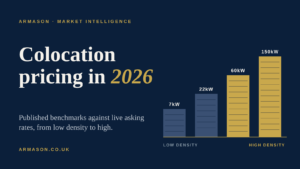
Power density is the defining infrastructure challenge of the AI era. A typical enterprise server rack draws 5 to 10kW of power. An AI rack packed with modern GPUs routinely demands 40 to 80kW or more. NVIDIA’s Blackwell GB200NVL72 rack design requires approximately 132kW. The company’s roadmap shows systems requiring 250 to 600kW per rack by 2027.
The UK colocation market’s current density profile is mismatched with this demand. The most common rack density across the industry remains 5 to 9kW per rack, a figure that has held constant for years. Most existing UK data centres simply were not built for AI-scale power densities.
Cooling infrastructure
Air cooling alone cannot support current-generation GPU infrastructure at density. Facilities that genuinely support AI workloads require liquid cooling infrastructure, direct-to-chip, rear-door heat exchangers, or immersion cooling, that can handle 40kW per rack and above without relying solely on air movement.
This requirement is reshaping the UK colocation market. Colocation providers now include liquid cooling as a standard option to attract customers who need more GPU power. Facilities that cannot offer liquid cooling are structurally unable to serve the most demanding AI workloads, regardless of location or price.
Connectivity
AI training workloads, particularly large-scale distributed training across multiple GPU clusters, require high-bandwidth, low-latency interconnects between systems. InfiniBand networking, providing 400Gbps or higher inter-node bandwidth, is the standard for serious AI training deployments. Facilities that can support InfiniBand fabric across colocated GPU clusters command a significant premium.
For inference workloads, the connectivity requirement shifts toward external connectivity. from low-latency paths to cloud on-ramps, internet exchanges, and end-user populations. Carrier-neutral colocation facilities with multiple network options are better positioned for inference than single-carrier facilities, regardless of power density.
Operational expertise
Operating GPU infrastructure is materially different from operating conventional enterprise IT. Power monitoring and management at densities that leave no margin for error, liquid cooling system maintenance, and rapid thermal event response all require operational expertise that was not part of the standard UK colocation skill set three years ago.
The shortage of specialist data centre operations talent capable of managing AI infrastructure is a genuine constraint on the market’s ability to absorb the capacity being built. 48% of new data centre projects are now driven by AI and HPC requirements, but the operational workforce to run them has not grown at the same pace.
The UK market’s structural constraints on AI data centre delivery
The UK is structurally well positioned to serve AI data centre demand — strong connectivity, a large and sophisticated enterprise market, a supportive regulatory environment, and significant announced investment. The constraint is not appetite. It is delivery.
The vacancy rate has fallen from 27% in 2016 to 8% in Q1 2026. Pre-letting has become a core feature of the market, with future capacity increasingly committed well before completion. Only 48MW of new capacity was delivered in Q1 2026 — well below what the market requires.
Three constraints are binding simultaneously.
Power availability – the grid connection queue makes new grid-connected capacity slow and uncertain.
Planning – the system was not designed for infrastructure at this scale, and the regulatory environment is tightening.
Construction – specialist labour shortages, long equipment lead times for liquid cooling and high-density power infrastructure, and rising costs are all extending build timelines.
The UK AI data centre market will not lack demand, capital or strategic relevance. The decisive question is which projects can convert those advantages into deliverable capacity in a more constrained, regulated and execution-sensitive environment.
What this means for AI operators seeking UK capacity
For enterprise organisations, neoclouds, and AI companies seeking UK data centre capacity, the market dynamics in 2026 demand a different procurement approach than three years ago.
Start earlier. Enterprises that once planned infrastructure 6 to 12 months ahead are now securing capacity 18 to 24 months before deployment. Pre-letting is the norm for new AI-ready capacity. Reactive procurement will find limited options.
Be specific about requirements. Vague demand signals produce poor results in a tight market. Power density, total load, liquid cooling requirements, connectivity needs, and data residency obligations should all be defined before approaching the market.
Consider regional options. London dominates UK data centre supply but is the most constrained market. Manchester, Edinburgh, and regional colocation facilities outside the M25 corridor offer availability, lower pricing, and in some cases better power access, at the cost of some latency and connectivity depth.
Consider North American capacity for near-term GPU deployments. For organisations with immediate GPU deployment requirements that the UK pipeline cannot satisfy within required timelines, North American colocation capacity at Tier 3 facilities with four to six week delivery timelines is a viable alternative.
Armason: AI infrastructure advisory and capacity access
Armason holds relationships across the UK and international data centre operator market, including AI-ready facilities with liquid cooling, high-density power, and near-term availability. We match enterprise and AI operator requirements to available capacity, including inventory that is not publicly listed.
Sources referenced in this article
Spotlight: UK Data Centre Building Capacity H1 2026 — Savills
2026 Global Data Centre Outlook — JLL
AI data centre demand set to exceed capacity by 2027 — Data Centre News
UK data center market size and forecast 2026-2034 — Mordor Intelligence
AI and data centres — Business.gov.uk
GPU colocation: what AI infrastructure requires in a data center — Netrality