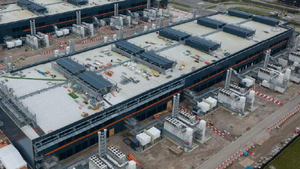
Nscale’s £2bn data centre in Loughton, Essex has planning permission, Nvidia backing, and Microsoft as anchor tenant. The project was announced by the Prime Minister during Donald Trump’s UK state visit, positioned as a centrepiece of Britain’s AI infrastructure ambition, and is designed to house up to 45,000 Nvidia GB200 GPUs at 90MW.
What it does not have is a confirmed grid connection. National Grid has told Nscale the 90MW connection needed for the site will not be ready in time for the facility’s planned 2027 opening — pushing the company into talks with Bloom Energy over solid oxide fuel cells as a bridge power source.
Nscale is not an outlier. It is the most publicly visible example of a failure mode that is running across the UK pipeline at scale. Understanding why it keeps happening — and what the alternative looks like — matters for every developer, operator, and capital provider active in UK data centre today.
The scale of the problem
Sightline Climate estimates that 26% of data centre capacity was delayed in 2025. Between 30 and 50% of global capacity expected in 2026 may face delays due to power constraints, equipment lead times, or local opposition. In the UK specifically, more than 100 projects have indicated they will turn to on-site gas generation as grid connection backlogs stretch beyond a decade in some areas.
The grid connection queue grew dramatically as AI-driven demand produced a wave of applications. Contracted demand connection applications rose from 41GW in November 2024 to 125GW by June 2025, with data centres accounting for at least 80GW of that total. The queue contains 315 data centre projects requesting around 73GW — substantially more than Britain’s peak electricity demand of approximately 45GW last year.
Ofgem’s response — a proposed Data Centre Commitment Fee ranging from £237,500 to £712,500 per MW, payable on accepting a connection offer — is designed to clear speculative applications from the queue. For a 40MW project, this could represent between £9.5m and £28.5m at risk. The practical effect for developers with genuine programmes is that the queue is long, the commitment is material, and the timeline to connection for new applications in high-demand areas remains measured in years.
The sequencing problem
How most pipelines are still being built
The failure mode that produced the Nscale situation, and that is producing delays across the wider UK pipeline, follows a consistent pattern. Land is identified and optioned. Planning is commenced, often in parallel with capital raising. Commitments are made to investors on a development timeline that assumes a grid connection can be secured within a given window.
Only at this point — after land has been optioned, planning has been filed, and capital has been committed — does the project team discover that the queue at the nearest substation runs to 2031, or that the substation itself is at capacity and the nearest alternative connection point is 15km away and requires a new primary substation.
At that moment, the project holds land it cannot power, capital committed against a timeline it cannot meet, and planning consent that begins to age while the programme stalls.
Why the old sequence no longer works
Until 2022, grid connection was a significant but manageable variable in UK data centre development. Timelines were long but predictable. The queue was real but navigable. Developers who understood the landscape planned for it.
What changed was the scale and speed of AI-driven demand. Projects that were banking on a 24-month connection timeline discovered they were in a queue that had grown by over 200% in under 12 months. The assumption that power would be available on a reasonable timeline — broadly correct for most of the sector’s development history — was no longer safe.
Capital committed before the power position is confirmed
The second driver of pipeline failure is the pressure to commit capital before the power position is confirmed. Infrastructure investment has deployment timelines. Funds have windows within which they need to allocate. Developers face pressure from investors to show programme progress.
The result is that investment decisions are regularly made on the basis of a conditional grid enquiry rather than a confirmed connection offer. Access to capital alone cannot overcome infrastructure bottlenecks — Nscale closed a $900m credit facility only weeks before the Essex grid problem became public. A conditional enquiry is a place in a queue, not a power position. Projects funded on this basis carry a risk that is not reflected in their financial model.
Demand assumptions that do not survive contact with the market
The third driver is the mismatch between demand assumptions and market reality. A project designed for hyperscaler demand needs a hyperscaler committed to it — not a reasonable assumption that hyperscaler demand will materialise post-completion. A project designed for AI infrastructure needs an operator with the specific power density, cooling specification, and connectivity requirements that AI workloads demand.
The UK data centre market runs at around 8% vacancy, with 96% of new capacity pre-let before completion. This tells you the market is tight — not that the capacity you are building will be absorbed by the customer type your financial model depends on. Projects that assumed demand would find them, rather than securing committed demand before building, have discovered the hard way that those are not the same thing.
What the Nscale situation actually illustrates
The value of the Nscale situation as a reference point is that it is so publicly visible. Every ingredient for a successful project was in place. The bottleneck is physical, not financial. AI is sold as software. It runs on electricity. And electricity, unlike capital, cannot be raised in an afternoon.
For the rest of the UK pipeline, the lesson is not that large-scale AI data centre development in the UK is impossible. It is that the critical path for any UK data centre development now runs through power. A site without a confirmed grid connection, or a credible alternative power strategy, is a land asset with planning potential — not a data centre development with a reliable programme.
The sequencing that is actually working
Projects completing on programme in the current UK market share a consistent characteristic: power was assessed first, before land was optioned and before capital was committed.
In practice this means grid connection enquiries submitted before planning applications were filed. The connection timeline driving the development programme, not the other way around. A confirmed connection offer — or a credible private wire or on-site generation alternative — in place before capital is committed to a construction schedule.
It also means that where grid connection timelines are unacceptable, alternative power routes are assessed early. Private wire from a nearby industrial or substation connection, on-site gas or diesel generation as a bridging strategy, battery storage as a peak management tool. These decisions are straightforward to make before land has been optioned and capital committed. They are expensive and often unworkable after.
The anchor tenant variable
One factor that consistently distinguishes completing projects from stalling projects is whether committed demand was secured before the development programme was locked.
An anchor tenant does not just fill capacity. It changes the financial structure of the project. It provides the revenue certainty that construction lenders require before releasing finance. It reduces the post-completion absorption risk that equity investors price into their return expectations. And it compresses the timeline from completion to revenue — the variable that most directly determines return on capital for a development programme.
Projects with committed anchor demand, contracted before planning was determined, are completing. Projects that assumed demand would arrive post-completion are the ones stalling.
What this means for capital allocators and developers
For investors evaluating UK data centre development opportunities, the pattern has a direct implication for screening criteria. The power position needs to be assessed as a primary filter at the investment evaluation stage, not as a secondary due diligence item post-commitment.
A project with a confirmed grid connection at the right capacity, a credible construction programme, and a committed anchor tenant is a materially different investment from a project with land, planning consent, and a conditional grid enquiry. Both may present similar headline return projections. The probability of delivering those returns is not comparable.
The UK data centre market remains one of the most active in Europe for capital deployment, and the underlying demand drivers — AI infrastructure, enterprise compute, sovereign cloud — are genuine and persistent. But the pipeline is not uniformly investable. The projects that will complete are the ones where the sequencing was right from the start.
Armason: sequencing advisory and capacity sourcing across the UK data centre market
Armason works with operators, developers, and capital providers across the full UK data centre development lifecycle. We track power availability, grid connection status, and committed demand across the UK market. We work on the dependency chain — grid, demand, capital, construction — that determines whether a programme completes or stalls.
If you are evaluating a UK development programme or sourcing capacity for an AI or enterprise deployment, contact the Armason team.
Related reading
· Data centre grid connection in the UK: timelines, queues and what operators need to know
· Ofgem first ready first connected: what the grid queue reform means for data centre developers
· Finding data centre sites with power in the UK: why grid connectivity is now the critical constraint
· AI Growth Zones UK: what they actually mean for data centre developers and grid access
Sources referenced in this article
· Nscale’s £2bn Essex data centre hit by grid delays — Data Centre Review
· What are the factors delaying Nscale’s $2.6bn UK investment? — Data Centre Magazine
· Grid delays force Starmer-backed AI data centre to seek alternative power — City AM
· Ofgem acts to free up grid capacity by tackling speculative data centre projects — Ofgem
· Pay to Stay: Ofgem’s plan to cull the data centre connection queue — Slaughter and May
· Data centres now Nationally Significant Infrastructure Projects — Norton Rose Fulbright