This week in UK data centres:
- The Telegraph reports that Microsoft, one of Nscale’s two largest customers, has terminated its agreement for the Loughton, Essex data centre, with no reason given and Nscale saying it remains committed to the site
- EDF backs an Ofgem queue charge in principle but says the top of the proposed fee range risks over-correction, and asks for a fee-free exit where network delays are the cause
- Gas on site is the contested alternative to a slow grid, with campaigners challenging AVK’s gas microgrids and unproven carbon capture, while trial evidence suggests flexible AI demand could ease some pressure
A reported tenant exit at Loughton shows what an uncertain power date costs.
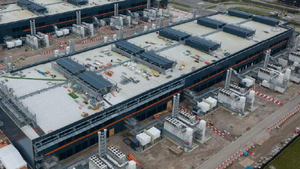
The Telegraph reported, as relayed by Reuters, that Microsoft has pulled out of a data centre deal with Nscale and recently terminated its agreement for the Loughton, Essex site, and the report did not say why. Reuters describes Microsoft as one of Nscale’s two largest customers, and notes that Nscale filed for a US IPO last month. Neither company had responded when Reuters published.
The Next Web, summarising the Telegraph report, says the site has faced repeated delays, that authorities have told Nscale not to expect a power supply until the 2030s, and that it reported in July that the grid could not connect the site in time for its planned opening. Nscale’s spokesman told the Telegraph that the company remains committed to the site, is looking at other power sources and UK locations, and that its relationship with Microsoft remains strong and long term. The reason for Microsoft’s exit is not confirmed, and the story rests on one newspaper’s reporting, so it is best read as a signal rather than a finding.
Whatever the reason, the pattern is the one lenders and tenants describe. A lease is only as firm as the connection behind it. A tenant that has committed capacity to a site with no firm energisation date holds an option, not an asset, and tenants are choosing between sites on the strength of a delivery date.
Commentary on the same event frames it as a grid story. Simply Wall St’s note on Yahoo Finance says electricity networks and equipment providers “still control the literal on switch for AI”, and names Drax, Volex and Invinity as UK-listed companies exposed to grid and battery demand. It is stock commentary rather than analysis of the site, but the framing matches the market’s. Power is the gating item.
Sources: Microsoft pulls out of UK data center deal with Nscale, Telegraph reports (Reuters via Investing.com) | Microsoft reportedly quits Nscale’s UK data centre weeks before its IPO (The Next Web) | 3 UK grid stocks retail investors are watching for AI data centre demand (Simply Wall St via Yahoo Finance)
The queue fee debate is moving from whether to charge to how much, and who bears the delay.
EDF’s Let’s Talk Power blog says it supports the principle of a queue charge to discourage speculative projects, but that the upper end of Ofgem’s proposed range, which it gives as £240k to £710k per MW, is at high risk of producing an over-correction. It cites demand connection applications rising from 41GW to 125GW in less than a year, mostly from data centres.
EDF’s other asks are as specific. Developers facing delays or cost rises caused by network factors should be able to exit without a termination fee. Network operators should face stronger accountability for timely delivery when developers make large financial commitments. And after queue reform, the focus should shift to meeting connection dates and resolving barriers for credible projects. It also lists long-term power purchase agreements, co-location with generation or storage, on-site batteries and demand flexibility as ways to ease pressure on the network.
Flexibility is the item with the newest evidence. International Banker argues that “everything-to-grid” coordination of flexible loads, storage and distributed generation could let data centres earn earlier connections or lower charges, citing a December 2025 Nature Energy trial in Phoenix in which a 256-GPU cluster cut its power draw by 25% for three hours, and a June 2026 study in which a 130kW cluster in London responded to 22 simulated and live dispatch events. The article is clear that these show technical feasibility and do not prove the same performance at hyperscale.
The two pieces point the same way. If the queue is to reward credible projects, a developer that can show flexibility, storage or on-site generation has more to offer the network than one asking for firm capacity at full load from the first day. Flexibility is also a project variable that lenders will price, and International Banker lists curtailment obligations, service guarantees, battery degradation and warranty limits among the trade-offs.
Sources: Getting data centre connections reform right (EDF) | Everything-to-grid: can flexible power ease the data centre bottleneck? (International Banker)
Gas on site is becoming the contested answer to a slow grid.
DeSmog reports that AVK, a UK supplier of data centre power, is promoting gas-powered data centres alongside carbon capture that it has not yet delivered, and that AVK operates a 90MW gas microgrid at Pure DC’s Dublin campus and is piloting two gas microgrids with carbon capture in northern England. AVK told DeSmog that it believes in the technology, that it has not found a route to meeting data and AI demand without a transitional role for gas, and that it has not yet delivered a carbon capture scheme.
DeSmog also cites Future Energy Networks as counting more than 100 gas connection requests from data centres since 2024. Critics quoted in the piece are blunt. Oil Change International’s Aled Dilwyn Fisher calls carbon capture “fundamentally flawed, extremely expensive, and has a long history of spectacular failure”, and Global Action Plan’s Oliver Hayes calls AVK’s campaign PR for the gas industry.
This is the other side of the on-site generation argument developers are making. EDF lists co-location with generation and on-site storage as routes to ease network pressure, and DeSmog shows what the argument looks like when the generation is gas. A developer proposing on-site gas now has to answer the emissions question at planning as well as the connection question. The credible route is the one that can show what it burns, what it captures and who verifies it.
Sources: UK data centre power supplier accused of giving “lifeline” to fossil fuel industry (DeSmog)
Also this week: bills, and the parts of the market that are not about the grid.
The Times ran a piece headlined that data centre expansion could push up energy bills, energy chiefs warn, which is the consumer-facing version of the cost-allocation question running through the queue debate.
Data Centre Dynamics’ UK and Ireland feed carried several items that are not about the grid: Orcadian Energy ending its agreement to host a data centre at a North Sea gas field, Echion and Proper Voltage developing a 1.6MW UPS for AI data centres, Orca Computing deploying a photonic quantum system at Digital Realty’s LHR19 site in London, and a hollow-core fibre trial by Colt, Relativity Networks and NPS on a London network. They are small signals, but they show equipment, quantum and fibre investment continuing around the power constraint.
Sources: Data centre expansion could push up energy bills, energy chiefs warn (The Times) | UK and Ireland (Data Centre Dynamics)
The week in one line: a tenant’s reported exit from a site with no firm power date, a utility asking for a fairer queue fee and a row over gas microgrids all say the same thing. The power plan is what the market tests first.
Armason tracks infrastructure signals across the UK and European data centre market. For site availability, grid intelligence, or pipeline advisory, visit armason.co.uk.
Related reading
· Data centre grid connection in the UK: timelines, queues and what operators need to know
· The Ofgem data centre commitment fee: what operators with grid positions need to do
· On-site power generation for data centres in the UK: why the grid queue is accelerating the shift
· Why most UK data centre pipelines fail before they complete