This week in UK data centres:
- A major Scotland data centre faces strong local opposition as the planning battle intensifies
- A new industry initiative aims to standardise grid connection infrastructure to accelerate UK delivery
- Google’s Hertfordshire data centre shows what responsible hyperscale looks like — and why it remains the exception
Scotland’s planning landscape is hardening. The Westerhill battle is the clearest signal yet.
Apatura’s proposed 300MW AI Energy Campus at Westerhill, located within the Westerhill Regeneration Masterplan between Bishopbriggs and Lenzie in East Dunbartonshire, is facing significant and organised local opposition ahead of its formal planning submission. Residents have raised concerns about water consumption, electricity demand, continual operational noise, and the site’s proximity to homes.
A further complicating factor: in 2023, the Scottish Futures Trust led work to identify the most suitable locations for future large-scale data centres in Scotland — and Westerhill did not feature on either the published longlist or shortlist. For a developer seeking planning approval, that absence from the strategic location analysis is a meaningful gap in the site’s case.
The Westerhill story does not stand alone. Plans for a 213MW data centre on the former RBS headquarters site in west Edinburgh were unanimously rejected earlier this year, despite planning officers recommending approval. The facility was marketed as a green data centre powered by renewable energy. Councillors concluded it did not satisfy the criteria for a genuinely green scheme — and the lack of any clear definition of what a green data centre means was repeatedly flagged during the hearing.
The Scottish Government has been urged to press pause on data centre planning applications, with campaigners arguing that if any of the proposed hyperscale sites are approved, they would use the energy of an entire city. The pipeline of proposed Scottish development is large — 17 or more sites at various stages — but the planning and community engagement risk attached to individual projects is growing at pace.
A supportive national policy environment for digital infrastructure does not automatically translate into local planning approval. The developers who will succeed in Scotland are those who can demonstrate genuine local benefit, credible sustainability credentials, and alignment with the Scottish Futures Trust’s preferred location work.
Sources: Dunbartonshire Liberal Democrats — The proposed Hyperscale Data Centre at Westerhill | Action to Protect Rural Scotland — Edinburgh Data Centre Refused | The Scotsman — Revealed: 17 locations of Scotland’s new hyperscale data centres | Apatura — Westerhill AI Energy Campus
A new industry initiative is trying to standardise how data centres connect to the grid.
United Infrastructure has been asked by stakeholders to formulate a series of standardised electricity connection archetypes designed to accelerate grid connectivity for the UK’s rapidly growing data centre sector, following a roundtable event in Cardiff. The logic is straightforward: if the design of grid connections is standardised across the industry, procurement timelines compress, regulatory approval is faster, and network operators can plan more efficiently.
The grid connection process in the UK is currently bespoke for every project — each developer, each site, and each network operator working through a unique configuration of technical requirements, legal agreements, and construction specifications. The cost and time associated with that bespoke approach is a meaningful contributor to why connection timelines stretch to a decade. Standardised archetypes would reduce the design and approval burden on both sides of the connection.
Separately, Ofgem has confirmed it is developing Connect Accelerate, a framework under which large energy users will have the legal right to self-build and own, or self-build and transfer, high-voltage transmission assets. A formal consultation is expected in autumn 2026. Combined with standardisation, the direction of travel is clear: data centre developers are being given more tools to resolve their own grid constraints rather than waiting for regulated operators.
The practical benefit is not immediate. Standardisation frameworks and regulatory changes take time to embed, and the underlying infrastructure constraint — the physical gap between available grid capacity and genuine demand — is not resolved by process improvements alone. But for developers building pipeline projects now, the trajectory matters. The grid access environment in 2028 will be materially different from the one that stalled Nscale in Essex.
Sources: New Civil Engineer — United Infrastructure to develop data centre grid connection standards | Greenberg Traurig — The New Race for Power: What Ofgem’s Grid Reform Means for Data Centre Development
Google’s Hertfordshire facility shows what clean power actually looks like — and why it remains rare.
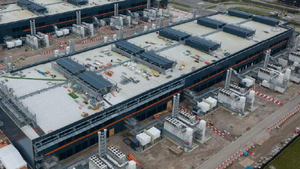
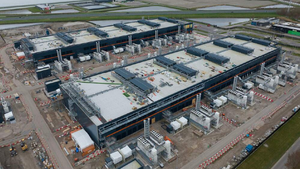
Google has opened its new data centre in Waltham Cross, Hertfordshire, as part of its £5bn UK investment programme. The facility uses advanced air-cooling to minimise water use and is prepared for heat recovery — surplus heat can be distributed to nearby homes, schools, and businesses. Google has partnered with Shell Energy Europe to manage its UK carbon-free energy portfolio, using battery storage to balance output from the Moray West offshore wind project in Scotland and other clean energy sources.
Between the Shell arrangement and other clean energy initiatives, Google’s UK operations are projected to run at or near 95% carbon-free energy in 2026. Despite navigating a 37% annual increase in electricity demand, Google reduced its operational emissions by 2% year-over-year in 2025 while matching 100% of its electricity consumption with renewable energy purchases for the ninth consecutive year.
The Waltham Cross facility is useful as a reference point precisely because it represents what is achievable when a well-capitalised developer with a long-term sustainability commitment designs for clean energy from the outset. It is also, in the context of the wider UK pipeline, an outlier. Most projects in 2026 are not in this position.
The combination of grid constraints, cost pressure, and delivery urgency is pushing the majority of developers toward gas bridging rather than renewable-first power strategies. The Edinburgh planning refusal reflects this gap directly — a facility marketed as green that the planning committee concluded did not meet the standard the label implies. The question the market needs to answer is whether that gap is a temporary feature of a constrained delivery environment, or a structural tendency that will persist as demand grows.
The gap between Google’s clean energy benchmark and the gas-bridging reality of most pipeline projects is not primarily a technology problem or a commercial problem. It is a planning and infrastructure sequencing problem. The clean energy is available. The grid to deliver it is not.
Sources: Data Centre Dynamics — Google opens Hertfordshire data center as part of £5bn UK investment | Solar Power Portal — Shell to manage renewable energy supply for Google UK data centre | Google — 2026 Environmental Report
The week in one line: Scotland’s planning environment is hardening against data centre development, a new industry initiative is attempting to standardise grid connections to compress delivery timelines, and Google’s Hertfordshire facility illustrates both what clean power looks like and how far most of the pipeline is from achieving it.
Armason tracks infrastructure signals across the UK and European data centre market. For site availability, grid intelligence, or pipeline advisory, visit armason.co.uk.
Related reading
Scotland data centre development: why it’s becoming the UK’s most viable emerging market
UK Data Centre Intelligence — Week Commencing 20 July 2026
Ofgem first ready first connected: what the grid queue reform means for data centre developers
On-site power generation for data centres in the UK: why the grid queue is accelerating the shift