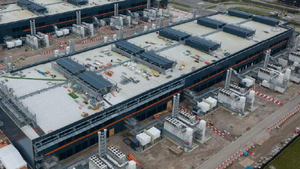
The UK hyperscale data centre pipeline has never been larger in headline terms. Billions of pounds of announced investment, millions of square feet of planned capacity, dozens of planning applications at various stages. The numbers are real. So are the constraints that sit between announcement and delivery.
This article maps the current state of UK hyperscale data centre development — what the pipeline actually looks like, who is driving demand, what the structural constraints are, and where development is realistically heading over the next five years. The gap between the headline pipeline and the capacity that will actually be built is significant, and understanding it is essential for anyone investing in, developing, or seeking to access UK hyperscale infrastructure.
Defining hyperscale in the UK context
Hyperscale is a term that gets applied loosely across the data centre industry. In the UK context, it is most usefully defined by power capacity: facilities of 50MW IT load and above, typically developed for single occupiers or with large blocks of capacity pre-committed to hyperscale cloud providers, AI operators, or sovereign compute programmes.
Below 50MW, the market operates as standard colocation — multi-tenant, flexible, with a range of operators and commercial structures. Above 50MW, the market becomes qualitatively different: longer procurement timelines, bespoke grid connections, complex planning requirements, and capital commitments that require institutional-grade financing. It is in this upper range — 100MW, 200MW, 500MW and above — that the most significant UK development activity is now concentrated.
The UK hyperscale pipeline
Announced and committed projects
The most significant hyperscale commitments in the UK are the major cloud provider programmes. Amazon’s £8bn data centre programme through 2028 is adding more than 1GW of capacity across multiple UK regions. Microsoft has expanded its UK estate across multiple sites to support high-density AI and sovereign cloud workloads. Google has opened its Waltham Cross, Hertfordshire facility as part of a £5bn UK investment programme.
Beyond the hyperscale cloud providers, the pipeline includes several large-scale campus developments at various stages of planning and development. The £3.75bn DC01UK project at South Mimms in Hertfordshire has secured local planning approval. Blackstone is developing a 720MW campus at Cambois in Northumberland on the former Blyth Power Station site. ILI Group has applied for a 600MW Stoic campus in Fife, Scotland. Apatura has secured 2.3GW of grid connections across nine Central Belt sites.
In the Devon project — 1.5GW of AI data centre capacity with 1.8GW of battery energy storage — Xlinks has proposed the most ambitious single-site development in the UK pipeline, though it remains at pre-application stage and faces significant local opposition.
The pipeline in context
Ofgem data shows that 140 proposed UK data centre projects have collectively requested approximately 50GW of grid connection capacity. Of those, 71 have made a financial commitment and reached Final Investment Decision, representing approximately 20GW. The remaining 70 or so are at earlier stages — some will progress, many will not.
Savills H1 2026 data shows that while London accounts for 240MW of capacity under construction and 1,652MW of committed capacity, the vast majority of the wider pipeline — approximately 9,371MW — remains early stage, where grid access, planning outcomes, and financing are still uncertain.
The distinction between the announced pipeline and the deliverable pipeline is the most important analytical lens for anyone evaluating UK hyperscale market exposure. Headline numbers overstate near-term delivery significantly.
Supply is expanding on paper, but much of the pipeline remains early-stage and uncertain. The constraint is not appetite, but the availability of genuinely deliverable capacity. Power is now the primary gatekeeper of growth.
Who is driving hyperscale demand
Hyperscale cloud providers
AWS, Microsoft Azure, and Google Cloud are the anchor tenants of the UK hyperscale market. Their programmes are long-dated, well-capitalised, and strategic rather than opportunistic — the UK is a tier-one market for all three, driven by enterprise cloud adoption, sovereign compute requirements, and the depth of the financial services sector.
Hyperscale cloud demand is also the most predictable category of hyperscale demand. The providers publish investment commitments publicly, their procurement timelines are known to the market, and their technical requirements are well-understood. For operators and developers building large-scale facilities, hyperscale cloud commitments provide the anchor demand that makes development economics work.
Neoclouds and AI operators
A new category of infrastructure provider has emerged directly in response to AI demand: neoclouds that offer GPU-as-a-service optimised for AI training and inference. These players are now competing directly with hyperscalers for capacity, accelerating take-up and pushing facilities to technical limits that were unthinkable a few years ago.
Neocloud demand is less predictable than hyperscale cloud demand. The sector is growing rapidly but is also more volatile — capital availability, customer commitments, and technical roadmaps can all change faster than for established cloud providers. For operators and developers, neocloud demand represents both a growth opportunity and a counterparty risk that requires careful evaluation.
Sovereign compute
The UK government has established AI Growth Zones with the specific objective of accelerating domestic AI infrastructure development. Sovereign compute — AI infrastructure operated under UK jurisdiction and governance — is increasingly a discrete demand category, driven by national security compute, NHS digital transformation, financial market infrastructure, and public sector AI deployment.
Sovereign compute requirements create a demand category that is genuinely location-constrained in a way that commercial AI training is not. UK data residency is a regulatory requirement, not a preference. This creates a floor of domestic demand that will persist regardless of what happens in the broader global data centre market.
The structural constraints on UK hyperscale delivery
Power and grid connection
Power availability is the binding constraint on UK hyperscale development. The grid connection queue held 125GW of contracted offers against a GB peak electricity demand of 45GW — a ratio that makes clear why the queue is the primary development constraint for any project requiring a new large-scale grid connection.
The Ofgem TMO4+ reforms are addressing the speculative element of the queue. The physical infrastructure constraint — the substations, transmission lines, and network reinforcement required to actually deliver power to the sites where developers want to build — is not resolved by regulatory reform. It requires construction, and construction takes time.
For projects above 100MW, grid connection timelines routinely run to eight to ten years for new transmission-level connections in constrained areas. This is the primary reason that large-scale UK hyperscale development is shifting toward: on-site generation and private wire, AI Growth Zone locations with grid prioritisation, regions with legacy industrial power infrastructure, and phased development that manages grid timing risk.
Planning complexity
The planning environment for large-scale data centres has become materially more complex over the past 18 months. The Edinburgh 213MW refusal despite officer recommendation, the Iver £1bn reversal by the Ministry of Housing, the organised opposition to Westerhill and Devon — these are not isolated incidents. They reflect a pattern of increasing scrutiny from local planning authorities, environmental campaigners, and community groups.
The NSIP route — Nationally Significant Infrastructure Projects, which routes approval through central government rather than local authorities — is available for the largest projects and is explicitly intended to address this. Three projects have already been directed into the regime. But NSIP is not a shortcut: the process is rigorous and the timeline is still measured in years, not months.
Construction and labour
Electrical work accounts for 45 to 70% of total data centre construction cost, and skilled electricians are the most constrained input in the entire system. Project backlogs for contractors taking on data centre work sit at 8.5 to 12 months. The specialist labour shortage is a structural rather than cyclical problem — the training pipeline for data centre construction skills is not producing qualified personnel at the required rate.
For hyperscale projects, the construction labour constraint is compounded by the scale and technical complexity of the facilities. A 200MW hyperscale campus is not simply a larger version of a 10MW enterprise facility — it requires a different supply chain, different commissioning expertise, and a different project management capability than most UK contractors have built in the decade of smaller-scale development.
Capital and financing
The constraint in 2026 is no longer whether banks will lend to data centre projects — it is whether the project has firm contracted power, a real customer pipeline, and a sponsor with operating credibility. The CNI designation from 2024 has opened UK clearing bank appetite into tier one deals, and institutional capital is actively seeking deployment in the sector.
ESG positioning has become a financing variable. Operators ignoring ESG positioning are pricing 50 to 100 basis points wider than ESG-positioned peers on identical asset profiles. Sites with PUE below 1.4, contracted renewable PPAs, and water-efficient cooling design unlock the deepest pool of capital at the lowest pricing. This is a meaningful commercial incentive to invest in sustainability infrastructure, not just a reputational one.
Where UK hyperscale development is heading
The UK hyperscale market will continue to grow — the demand drivers are structural and long-dated, the capital is available, and the government’s strategic intent is clear. But the growth will not be evenly distributed across the pipeline.
Projects that will get built share several characteristics. They have power sorted — either through AI Growth Zone grid prioritisation, on-site generation, or private wire arrangements that bypass the standard queue. They have planning credibility — either through the NSIP route, or through sites where local support and sustainability credentials are genuinely defensible. They have capital committed — not just announced, but structured and drawn. And they have contracted demand — anchor tenants or pre-lets that underwrite the development economics.
Projects that will stall or fail share the inverse characteristics. Power is uncertain, planning is contested, capital is conditional, and demand is aspirational rather than committed. These projects are real entries in the headline pipeline numbers and are not real near-term capacity additions.
The geography of hyperscale development is also shifting. London will remain the largest market — the connectivity, cloud ecosystem, and enterprise demand density are irreplaceable. But the growth at the margin is happening in the North East, Scotland, Wales, and the expanded London fringe, driven by the power availability that London cannot offer at the scale these projects require.
Bigger pipelines, tighter capacity. Execution is the new risk. The developers who will define UK hyperscale over the next five years are not those with the largest announced pipelines. They are those with the most credible path from announcement to operational capacity.
Related reading
AI data centre UK: what hyperscale and enterprise AI infrastructure demand looks like in 2026
Data centre grid connection in the UK: timelines, queues and what operators need to know
On-site power generation for data centres in the UK: why the grid queue is accelerating the shift
Data centre investment in the UK: why capital is abundant and execution is not
Sources referenced in this article
Spotlight: UK Data Centre Building Capacity H1 2026 — Savills
Meeting the UK’s compute capacity needs — Computer Weekly
Hyperscale data center buildout 2026 — iRecruit
UK Data Centre Development Finance Guide 2026 — FD Commercial
Finite resources could cause a data centre crunch in 2026 — E&T Magazine