Data centre site selection in the UK has been inverted. The criteria that drove site acquisition decisions for most of the sector’s development history — proximity to fibre networks, accessibility to labour, low flood risk, planning likelihood — remain relevant. But they are now secondary to the question that determines whether a project is viable at all: can we get power, and on what timeline?
Sites without secured power are increasingly stranded, regardless of their zoning or demand profile. That is not a temporary condition driven by the current grid queue — it is a structural feature of the UK data centre development market in 2026, and it is reshaping how developers approach site identification, option strategy, and the sequence of activities that lead to a committed development.
This article explains how data centre land acquisition in the UK actually works in 2026: what has changed in the site selection criteria, how the land market has responded to data centre demand, what the planning environment looks like, and what a credible site acquisition process looks like for a developer starting from scratch.
How site selection criteria have changed
Power first
The days of selecting a site based solely on cheap land and fibre proximity are over. Power availability has emerged as the first and most determinative criterion in UK data centre site selection. A site that scores well on every other dimension but faces a seven-year grid connection queue is not a viable development site — it is a stranded asset waiting for a queue that may or may not deliver.
In practice, power-first site selection means the following sequence: identify locations where substation capacity is available or where grid connection timelines are materially shorter than the market average; assess those locations against secondary criteria including connectivity, land availability, planning likelihood, and labour market; and only then evaluate the commercial terms on which land can be acquired.
This is the reverse of how site acquisition was typically conducted before the grid became the binding constraint. The old sequence — find the right location, then solve the power — produces stranded assets in 2026. The new sequence — find the power, then solve the location — is what developers who are actually building are doing.
The wider corridor of rights
Land strategy is no longer just about the site itself, but about securing the wider corridor of rights needed to make development possible. Third-party land consents for cable routes, pipework, and access are increasingly part of the critical path for UK data centre development. A development site that has planning consent but cannot secure the wayleaves for its grid connection cable route is not a deliverable site.
The land rights required for a data centre development now typically include: the development site itself, including any expansion parcels required for the phased build-out; access rights and road infrastructure for construction and operation; cable route corridors for grid connection from the point of connection to the site boundary; pipeline corridors for water supply and discharge where relevant; and in some cases, option agreements over adjacent land to protect against future obstruction of the cable route.
This expanded land rights requirement adds complexity and cost to the site acquisition process. Developers who do not assemble the full land rights package before committing significant capital to a site risk discovering, late in the development programme, that a third party’s land creates an insurmountable obstacle to connection.
AI Growth Zone alignment
AI Growth Zone designation comes with grid prioritisation, planning support, and in some cases direct government engagement with network operators on behalf of qualifying projects. For developers acquiring sites in or adjacent to designated AI Growth Zones — in Lanarkshire, the North East, South Wales, and others — these advantages are material and should be explicitly factored into site selection.
The grid prioritisation associated with AI Growth Zone status does not eliminate the standard connection process or guarantee a specific connection timeline. But it does mean that projects in these zones receive preferential treatment in the reformed queue — a meaningful structural advantage over projects outside designated areas competing for the same network capacity.
The UK data centre land market in 2026
Land values and competition
Data centre demand has caused significant inflation in industrial land values — between £8m and £15m per acre in key markets — increasing the costs of acquisition as well as overall ownership. In the primary corridors — Slough, West London, the M25 — this inflation reflects the combination of data centre demand and the broader pressure on industrial land from logistics, manufacturing, and mixed-use development.
Industrial land acquisition costs jumped 23% year-on-year in 2026 as developers sought larger parcels for campus development. For developers building business cases on land cost assumptions from 2022 or 2023, the current market is materially more expensive than their models assumed.
Competition for suitable sites is intense in established clusters. In the Slough and West London corridors, suitable industrial sites with adequate power access are effectively unavailable — the market has consumed them. Developers who are still looking for sites in these corridors are competing for a small number of brownfield sites and facing land values that require very high rental rate assumptions to produce viable development economics.
Brownfield versus greenfield
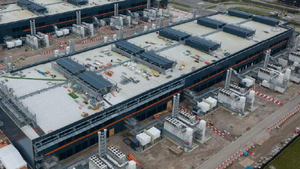
In constrained markets, brownfield redevelopment is becoming more popular — repurposing industrial sites with existing power and fibre infrastructure can accelerate delivery while supporting sustainability credentials. The Thames Valley Park project in Reading — the former Microsoft UK headquarters being redeveloped as a 72MW data centre — is the most prominent recent example of this approach.
Brownfield sites offer several development advantages: existing high-voltage infrastructure that may be usable or extensible, established access and service infrastructure, and in many cases a planning history that supports development. The disadvantages are contamination risk, existing structures that may need demolition, and in some cases restrictive covenants or third-party rights that complicate redevelopment.
For greenfield sites, the primary advantage is design flexibility — the ability to build a facility optimised for current and future requirements without adapting to existing structures. The disadvantages are the absence of existing power infrastructure, longer planning timelines for new development on previously undeveloped land, and the full land assembly challenge in locations where suitable parcels are not obviously available.
Regional land markets
Regional land markets outside London offer substantially different economics. In the North East, Scotland, Wales, and the Midlands, suitable industrial land with potential for data centre development is available at costs that are a fraction of the South East market.
The trade-off is not just connectivity depth — it is also the depth of the planning, advisory, and contractor ecosystem for data centre development in regional markets. The specialisms required for data centre development — specialist electrical contractors, data centre commissioning teams, planning consultants with sector experience — are more concentrated in the South East and require more deliberate supply chain management in regional locations.
The planning environment for data centre land acquisition
Standard planning routes
For most data centre developments, the standard local planning authority route remains the primary path to consent. The National Planning Policy Framework supports data centre development as economic infrastructure, and many local planning authorities in areas of strong digital demand have policies that are broadly supportive of the sector.
The challenge in the standard route is the inconsistency between authorities. Some have explicit data centre policies with defined criteria and relatively predictable outcomes. Others have limited experience of data centre applications and approach them on an ad hoc basis, which creates uncertainty and can significantly extend the consent timeline. Community opposition — increasingly organised and well-informed — is a growing factor in local planning decisions for larger developments, as illustrated by the Edinburgh and Westerhill refusals in Scotland.
The NSIP route for large projects
Since January 2026, data centre developments can opt into the Development Consent Order regime and seek classification as Nationally Significant Infrastructure Projects. The DCO process consolidates planning permission, highways consents, and compulsory acquisition powers into a single application determined by the Secretary of State rather than local planning authorities.
The NSIP route offers several advantages for large-scale developments: compulsory acquisition powers that can be used to assemble land and secure necessary rights for infrastructure; centralised decision-making that removes local variability from the consent outcome; and a single unified consent that incorporates associated permissions and licences. The process is rigorous and typically takes two to four years, but it removes the uncertainty of local planning outcomes for projects of genuine national significance.
There is currently no clearly defined category or fixed threshold setting out which data centre schemes qualify for NSIP status. The decision is made on a case-by-case basis by the Planning Inspectorate. Developers considering the NSIP route should seek specialist planning and legal advice before committing to the process.
What a credible site acquisition process looks like
A credible data centre site acquisition process in 2026 starts with power and ends with a fully assembled land rights position. The sequence matters.
Stage one: power assessment. Before any land is optioned, the power position at the candidate location should be assessed. This means formal engagement with the relevant DNO or NGET, not desktop analysis of published network data. The assessment should produce an understanding of available substation headroom, the likely reinforcement required for the required connection, the indicative connection cost and timeline, and the competitive queue position at the relevant connection point.
Stage two: land identification and option. Once a location with acceptable power has been identified, the land assembly process begins. This typically involves optioning the development site and any adjacent expansion land, identifying the cable route corridor and beginning engagement with third-party landowners along the route, and assessing the planning position and likely consent outcome for the development at the identified location.
Stage three: planning engagement and grid application. With land under option and the power position assessed, formal planning pre-application engagement and the formal grid connection application can proceed in parallel. These are both time-consuming processes and running them simultaneously rather than sequentially is important for keeping the overall development timeline manageable.
Stage four: full land rights assembly. As planning and grid connection progress, the full land rights assembly — including all wayleaves, access rights, and easements required for the connection infrastructure — should be completed before significant construction capital is deployed. Discovering a blocking third-party right late in the programme is expensive and sometimes fatal to a development.
The developers who are building in the current UK market have inverted the traditional site acquisition sequence. They find the power first, assemble the land rights second, and bring planning and grid connection forward in parallel. Developers still running the old sequence are producing stranded assets.
Armason: site identification and land access across the UK
Armason tracks power availability, substation capacity, and development site opportunities across the UK data centre market. We hold relationships with land and power owners, developers, and operators across the UK, and we work with developers and investors identifying and acquiring data centre sites.
We have sites available now with land secured and power in place — positions that avoid the grid connection uncertainty that most significantly affects development timelines and costs in the current UK market. If you are looking for data centre sites in the UK where the power question has already been answered, we would like to talk.
Contact the Armason team at jordan@armason.co.uk or visit armason.co.uk to discuss data centre site identification, land acquisition, and power advisory.
Related reading
Finding data centre sites with power in the UK: why grid connectivity is now the critical constraint
Data centre sites outside London: where power is actually available in the UK in 2026
Data centre grid connection in the UK: timelines, queues and what operators need to know
Data centre development costs in the UK: what projects actually cost to deliver in 2026
Sources referenced in this article
JLL: The perfect data centre land acquisition plan — Data Centre Magazine
UK data centre land strategy: challenges, risks and opportunities — Dalcour Maclaren
Key factors to consider for effective data centre site selection — CBRE
Spotlight: UK Data Centre Building Capacity H1 2026 — Savills
Data centres enter the NSIP regime — Forsters LLP
Data centre construction cost statistics 2026 — Axis Intelligence